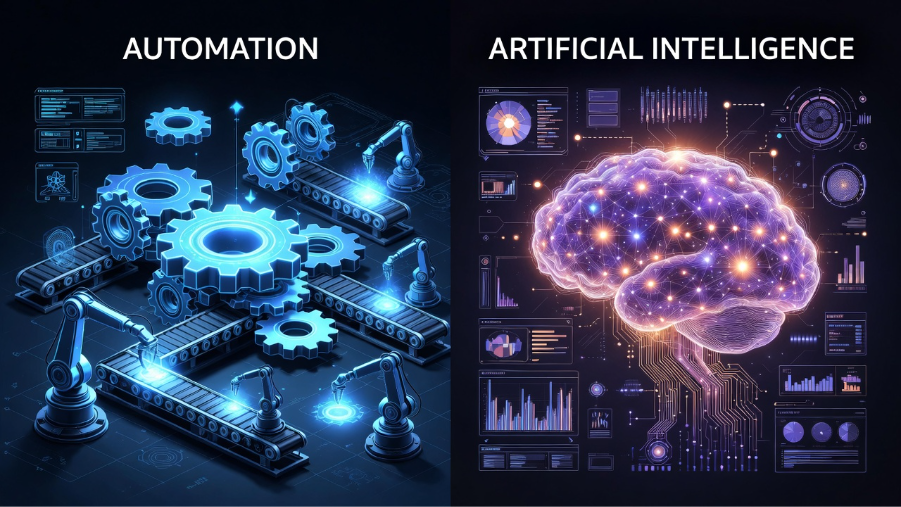

In the rapidly evolving landscape of information technology and cybersecurity, terminology is often abused. Marketing hype frequently conflates “automation” with “Artificial Intelligence (AI),” leading to inflated expectations and misaligned tech stacks.
For IT professionals and security analysts responsible for infrastructure and data defense, understanding the precise architectural differences between these two concepts is not an academic exercise—it is an operational necessity.
While both aim to increase efficiency and reduce manual labor, their foundational mechanisms, capabilities, and ideal use cases are vastly different. This article dissects the core distinctions between deterministic automation and probabilistic AI, helping you determine the right tool for the job.
The Deterministic Engine: Defining Automation
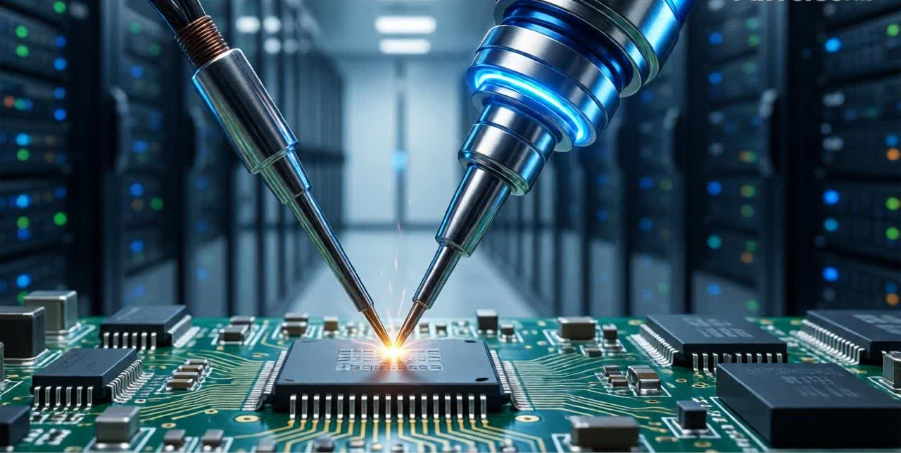
At its core, traditional automation is deterministic.
In IT infrastructure, automation is the application of technology to streamline processes without human intervention, based on pre-defined rules. It operates on an “If This, Then That” (IFTTT) logic framework.
An automated system does exactly what it is programmed to do—nothing more, nothing less. It requires structured data and a predictable environment. If the inputs match the pre-programmed criteria, the system executes the corresponding output. If an input falls outside those defined parameters, the system will likely fail or throw an error.
Key Characteristics of Automation:
- Rule-Based: Follows explicit, hard-coded scripts or workflows.
- Repetitive: Excel at high-volume, monotonous tasks.
- Static: The system does not “learn” from its actions; it only repeats them until reprogrammed by a human.
- Structured Data Dependency: Requires clean, predictable inputs (e.g., CSV files, specific log formats).
The IT Analogy: Automation is a highly efficient, tireless junior sysadmin running a perfectly written Bash script. They will execute the script 24/7 without error, but if a file name changes unexpectedly, they will stop and wait for instructions.
The Cognitive Leap: Defining Artificial Intelligence
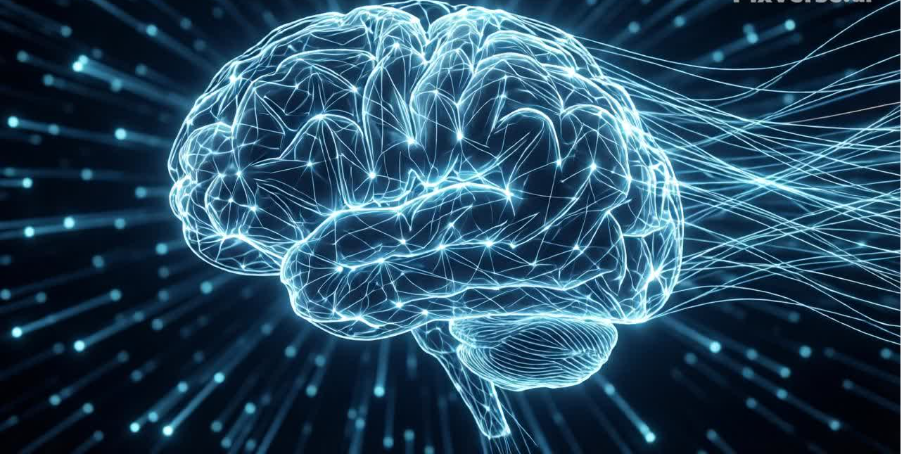
If automation is doing, AI is “thinking” (mimicking human cognition).
Unlike automation, true AI particularly subsets like Machine Learning (ML) and Deep Learning is probabilistic.
AI systems are designed to simulate human intelligence processes, including learning (acquiring information and rules for using it), reasoning (using rules to reach approximate or definite conclusions), and self-correction.
AI systems do not rely solely on hard-coded rules. Instead, they are trained on massive datasets. Through this training, they identify patterns, construct models, and make decisions or predictions based on new, unseen data. Crucially, an AI model can handle unstructured data (images, natural language text, anomalous network traffic patterns) and adapt its behaviour over time without explicit reprogramming.
Key Characteristics of AI:
- Pattern Recognition: Identifies complex relationships within data that humans couldn’t see.
- Adaptive (Machine Learning): The system improves performance as it is exposed to more data.
- Probabilistic Outcomes: It provides a confidence score or likelihood rather than a binary yes/no output.
- Unstructured Data Handling: Can process messy, real-world data inputs.
The IT Analogy: AI is a seasoned security analyst watching network traffic. They don’t just look for known bad IP addresses (rules); they notice that a user in accounting is accessing the database at 3 AM in a way that “feels off,” even if no specific rule is broken.
The Core Distinction: Deterministic vs. Probabilistic Architectures
For the technical professional, the difference comes down to how the system handles inputs to generate outputs.
| Feature | Automation (Deterministic) | Artificial Intelligence (Probabilistic) |
| Input Mechanism | Explicit programming & scripting. | Data training & model building. |
| Data Requirement | Structured, predictable data. | Structured and unstructured data. |
| Flexibility | Rigid. Breaks when variables change. | Adaptive. Can handle unseen variations. |
| Outcome | The same input always yields the same output. | The output is a prediction based on probability. |
| Goal | Efficiency and speed. | Decision-making and pattern discovery. |
Use Cases in the IT & Security Stack
To maximize ROI, IT leaders must deploy these technologies where their respective strengths lie.
1. Robotic Process Automation (RPA) & IT Scripting
- Ideal for Automation: User provisioning/deprovisioning, password resets, standard server patching, backing up databases at 2 AM, migrating structured data between legacy systems.
- Why: These tasks are repetitive, rule-based, and the inputs rarely change.
2. Cybersecurity Threat Detection
- The Automation Approach: A firewall rule that blocks any IP address attempting more than five failed SSH logins in one minute. This is effective for high-volume, known threats.
- The AI Approach (User and Entity Behavior Analytics – UEBA): A system that establishes a baseline of normal activity for every user on the network. It flags an alert if an executive’s credentials suddenly start exfiltrating large amounts of data to an unfamiliar external server, even if the login itself was technically valid.
- Why: Zero-day threats and insider attacks rarely follow pre-defined rules; they require pattern anomaly detection.
The Convergence: Intelligent Automation (IA)
The future is rarely “either/or.” The modern enterprise tech stack is moving toward Intelligent Automation (IA).
IA is the convergence of the two concepts: using AI to make decisions at critical junctures within an automated workflow.
For example, in an IT helpdesk scenario, an AI model (Natural Language Processing) could read an incoming ticket, understand the sentiment and urgency, categorize it, and then trigger a standard automation script to resolve the issue if it’s a known, simple problem. If the AI determines the issue is complex or novel, it routes it to a human engineer.
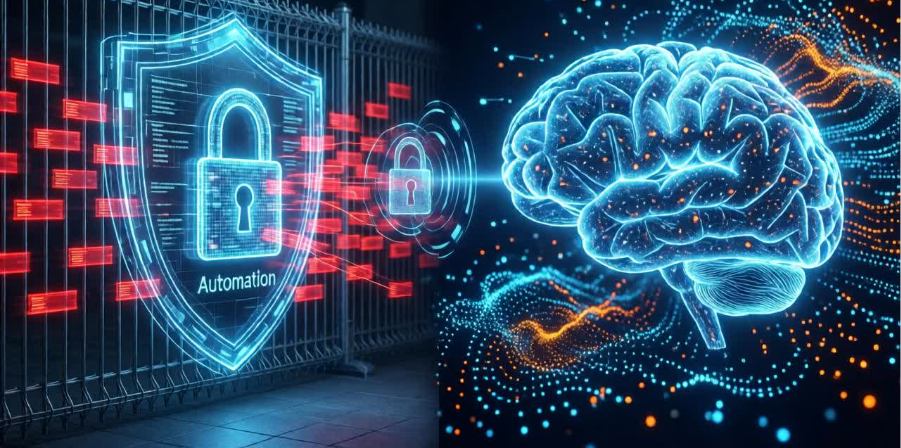
Understanding the fundamental difference between the engine of automation and the brain of AI is the first step toward building a resilient, efficient, and truly intelligent IT infrastructure.