

In 2026, the cost of a data breach in Nigeria has reached an all-time high, not just in fines, but in the total loss of consumer trust. As businesses increasingly use AI to process customer information, the Nigeria Data Protection Act and the NDPR have evolved to demand “Privacy by Design.”
If your business collects names, phone numbers, emails, or BVNs, you are a Data Controller. This step-by-step audit guide will help you ensure your “Human” and “Digital” layers are fully compliant.

Step 1: Conduct a Data Discovery Audit
You cannot protect what you don’t know you have. Your first step is to create a comprehensive “Data Map.”
- Identify the Data: What personal data are you collecting? (e.g., customer KYC, employee records, website cookies).
- The “Why” Factor: Under the NDPR, you must have a legal basis for every piece of data. Are you collecting it for a contract, legal obligation, or explicit consent?
- Storage & Lifecycle: Where is this data stored? Is it on a local server in Lagos, or a cloud server in the US? How long do you keep it before “shredding” it?
Step 2: The “AI-Privacy” Impact Assessment
In 2026, most compliance failures happen because businesses feed customer data into AI models without a Data Protection Impact Assessment (DPIA).
- Audit your AI Tools: If you use AI for credit scoring, recruitment, or marketing, you must ensure the algorithm isn’t “leaking” private data into public training sets.
- Automated Decision Making: The NDPR gives Nigerians the right to contest decisions made solely by AI. Ensure you have a “Human-in-the-Loop” for high-stakes decisions.
Technical Resource: For the latest official circulars on AI data processing, visit theNigeria Data Protection Commission (NDPC)portal.

Step 3: Designate or Outsource a DPO
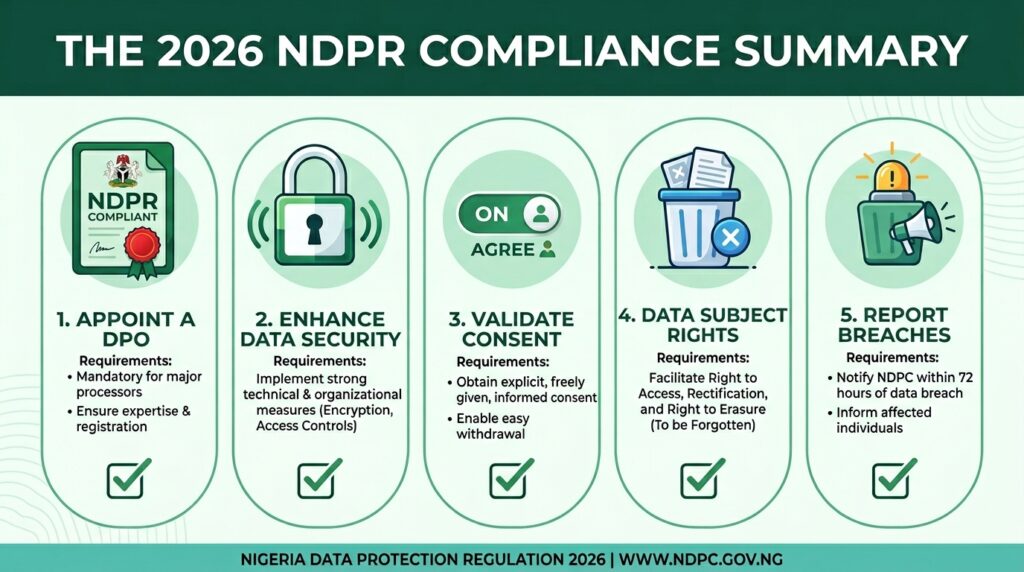
If you process personal data on a large scale, the NDPR requires you to appoint a Data Protection Officer (DPO).
- The Role: The DPO is your internal “Privacy Police.” They are responsible for training staff, managing data subject requests, and being the point of contact for the NDPC.
- DPCO Collaboration: Most Nigerian businesses work with a licensed Data Protection Compliance Organization (DPCO) to conduct their annual audits and file reports with the Commission.
Step 4: Technical Security Implementation
Compliance isn’t just paperwork; it’s code. Your IT infrastructure must support your privacy claims.
- Encryption at Rest & Transit: Ensure all customer data is encrypted using modern standards (AES-256).
- Access Control: Use the “Principle of Least Privilege.” A marketing intern should not have access to the full database of customer BVNs.
- Breach Notification Protocol: Do you have a plan to notify the NDPC within 72 hours of a data breach? In 2026, speed is a legal requirement.
The 2026 NDPR Audit Checklist
| Audit Area | Requirement | Status Check |
| Privacy Policy | Must be clear, in plain English/local context, and accessible. | [ ] |
| Consent | Must be “freely given, specific, and informed” (No pre-ticked boxes). | [ ] |
| Data Security | MFA enabled on all accounts and DBs encrypted. | [ ] |
| Staff Training | Regular awareness on handling personal data. | [ ] |
| Third-Party | NDPR-compliant contracts with all vendors (AWS, Paystack, etc.). | [ ] |
The Takeaway: Privacy is Trust
In Nigeria’s 2026 digital economy, customers are increasingly “Privacy-First.” They will do business with the company that respects their data and stay away from the one that treats it carelessly. By following this checklist, you aren’t just avoiding fines—you are building a brand that Nigerians can trust.
Would you like me to draft a “Standard Privacy Notice” template that you can adapt for your Nigerian business website this week?
NDPC: Guidelines on Data Protection Impact Assessment (DPIA)
This official resource provides the framework for Nigerian businesses to evaluate the risks of their data processing activities, especially when deploying new technologies like AI.