

The narrative of cybersecurity has shifted. We are no longer just defending “perimeters”; we are defending intent. As hackers leverage AI to automate vulnerability discovery and craft hyper-personalized phishing campaigns, the defensive community has responded by integrating AI into the very core of the Security Operations Center (SOC).
In 2026, the advantage is shifting toward the defenders who can most effectively orchestrate machine-speed response with human-level context.
1. Beyond Detection: The Shift to Autonomous Response
Traditional security tools were reactive: they waited for a signature match or a rule violation to trigger an alert for a human to investigate. In 2026, we utilize Autonomous Response.
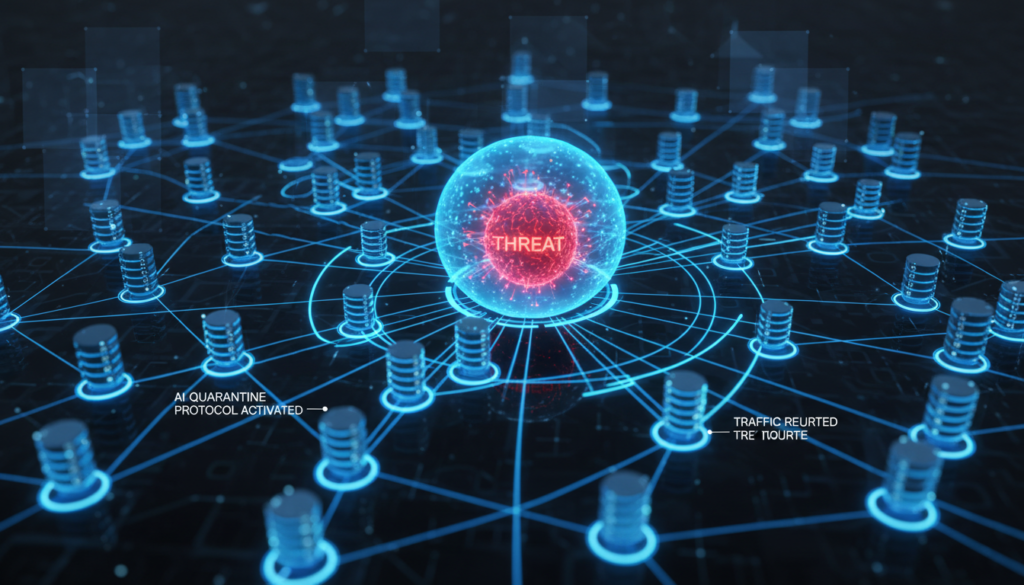
Modern platforms (such as those from Darktrace or Palo Alto Networks) don’t just alert; they act. If an AI detects a “Zero-Day” payload moving laterally through a cloud environment, it can instantly isolate the affected container, revoke the compromised identity’s tokens, and trigger a micro-segmentation policy—all in milliseconds.
- The Technical Edge: By the time a human analyst could even open the alert, the AI has already neutralized the threat, preventing the “Blast Radius” from expanding.
- Reduced MTTR: Mean Time to Remediate (MTTR) has dropped from hours to seconds for 80% of common attack patterns.
Industry Insight: According to theWorld Economic Forum’s Global Cybersecurity Outlook 2026, 94% of security leaders now consider AI the most significant driver of cybersecurity change.
2. Predictive Threat Hunting: Solving the “Non-Deterministic” Puzzle
The biggest challenge in 2026 is that AI-driven hackers are non-deterministic. They don’t follow a predictable script; they adapt.
To fight this, defensive AI uses Predictive Analytics. Instead of looking for known bad signatures, it builds a “Pattern of Life” for every user, device, and application. When a “Vibe Coded” module (AI-generated code) behaves in a way that is statistically anomalous, the AI flags it as a high-probability threat.
The 2026 Defense Stack:
- Behavioral Heuristics: Analyzing the intent behind data movement rather than just the file name.
- Threat Scoring: Using probabilistic models to assign a risk score $R$ based on factors like login location, velocity of data transfer, and credential privilege.
- Exposure Management: AI-driven tools now perform “Continuous Exposure Management” (CEM), proactively finding and patching vulnerabilities before a hacker can scan for them.
3. The Human-AI Hybrid: The 2026 SOC
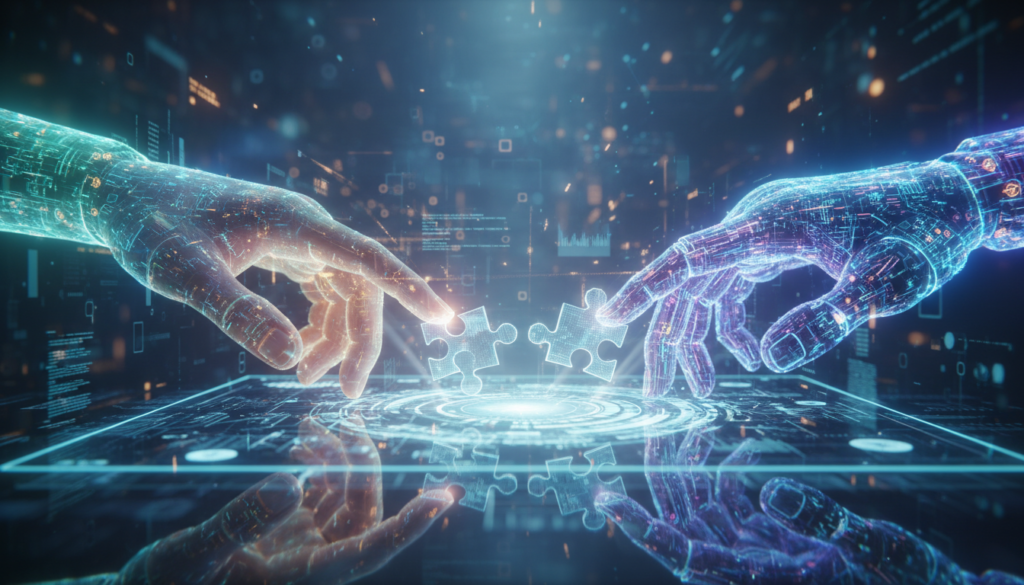
While AI handles the speed, human analysts provide the Context. The role of the IT professional in 2026 has evolved from a “Log Reader” to an “AI Orchestrator.”
We now use tools like Microsoft Security Copilot or Google Sec-PaLM to “interrogate” our data. An analyst can ask, “Show me all instances of lateral movement involving our AI training data in the last 24 hours,” and receive a visualized attack graph and a suggested remediation plan instantly.
Why Humans are Still Essential:
- Ethical Judgment: AI cannot decide the business impact of shutting down a mission-critical server to stop a minor infection.
- Strategic Reasoning: Understanding the “Why” behind a nation-state attack requires geopolitical knowledge that AI currently lacks.
- Governance: Ensuring the AI defense itself isn’t “hallucinating” or being manipulated through adversarial “Prompt Injection.”
Recommended Reading: Stay updated on the latest vulnerability research and AI-fied threats atThe Hacker NewsorDark Reading.
The 2026 Verdict: Resilient by Design
The “AI vs. Hackers” battle is no longer a game of cat and mouse; it’s a game of data quality and processing speed. The winners in this landscape are the organizations that treat security as a design discipline rather than a reactive function.
By leveraging AI for autonomous containment and predictive hunting, IT professionals are finally gaining the upper hand against the industrialized scale of modern cybercrime.