

An Incident Response Plan (IRP) is your “fire drill” for digital threats. It defines who acts, what they do, and how they communicate when the worst happens.
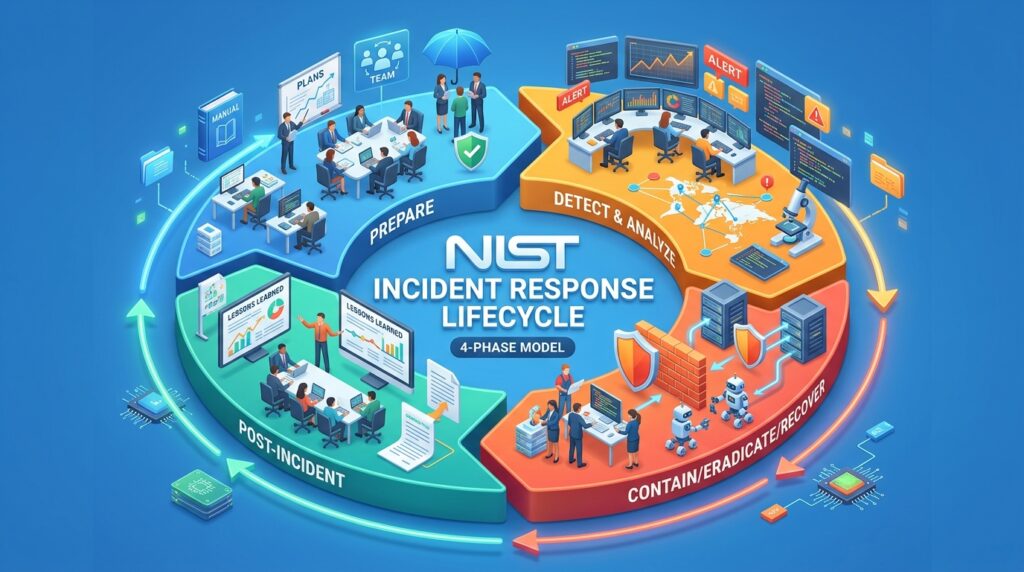
The 4-Phase NIST Lifecycle (2026 Standard)
- Preparation: This is your foundation. Build your team, list your critical assets, and define roles before the attack.
- Detection & Analysis: Use monitoring tools (like EDR/SIEM) to identify anomalies. Is it a real breach or a false alarm?
- Containment, Eradication & Recovery: The “Stop, Clean, Restore” phase. Isolate the threat, remove the malware, and restore from clean backups.
- Post-Incident Activity: The “Lessons Learned” phase. What happened? Why? How do we fix the vulnerability so it never happens again?
Free Incident Response Plan Template (SME Edition)
Copy and adapt this structure into a document your team can access offline.
1. Core Response Team (Who does what?)
- Incident Commander (e.g., CTO): Makes the final call to shut down systems.
- Technical Lead (e.g., IT Admin): Handles the “Containment” (isolating servers, resetting passwords).
- Communications Lead (e.g., CEO/PR): Manages messaging to customers and the NDPC.
- Legal/Compliance: Ensures all reporting follows the NDPR guidelines.
2. Trigger Matrix (When do we start?)
- P1 (Critical): Ransomware, full data leak, total service outage. Immediate activation of IRP.
- P2 (High): Unauthorized account access, suspicious data export. Activate within 1 hour.
- P3 (Medium/Low): Minor anomaly, phishing report. Review during next IT shift.
3. Communication Protocol
- Internal: Use a secure, out-of-band channel (e.g., Signal or an encrypted corporate portal). Assume your primary email is compromised.
- External: Draft template letters for customers now. Do not scramble to write them while under attack.
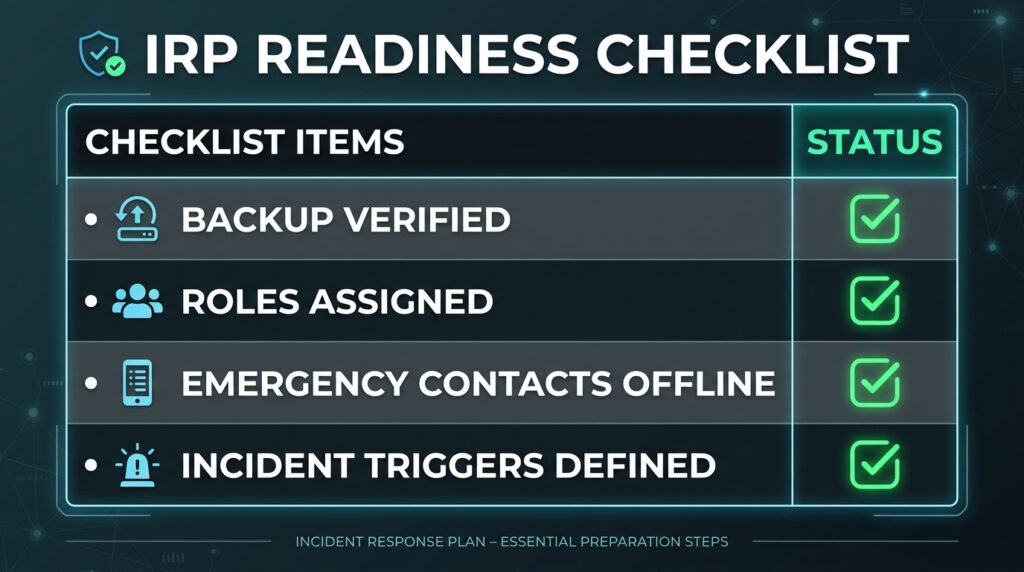
Key Checklist for 2026 Compliance
| Task | Action | Status |
|---|---|---|
| Backup Integrity | Verify 3-2-1 backup rule (3 copies, 2 media, 1 offsite). | [ ] |
| Out-of-Band Comm | Establish a backup messaging group for the IR team. | [ ] |
| Contact List | Print a physical copy of critical contacts (Legal, ISP, IT). | [ ] |
| Tabletop Drill | Run a 30-minute “simulated breach” with your team. | [ ] |
The Takeaway: Speed is Your Greatest Asset
In 2026, the average “dwell time” (how long an attacker spends in your system) is the metric that matters most. A simple, one-page plan that your team has actually practiced is infinitely more valuable than a 50-page manual that sits gathering dust on a shelf.
NIST Incident Response Guide This is the gold-standard framework for building your technical incident response procedures. Use this to ensure your internal processes match global security standards.