

In the Nigerian job market of 2026, the paper ceiling has effectively shattered. While a university degree was once the ultimate “ticket” to a corporate interview, the 2026 hiring landscape has undergone a radical transformation.
If you are hunting for a role in Nigeria’s booming fintech, tech, or corporate sectors today, you’ve likely noticed a trend: Employers aren’t asking “Where did you study?” as much as they are asking, “What can you ship?”
Here is the truth about what Nigerian employers are actually prioritizing in 2026.
1. The Death of the “Passive Degree”
In 2026, a degree is viewed as a baseline—a proof of discipline—but it is rarely proof of competence. Hiring managers at Nigeria’s top tech firms (like Flutterwave or Interswitch) and multinational banks are increasingly using Skills-Based Hiring.
They are looking for:
- The Portfolio Proof: Can you show a live application you built? Can you demonstrate a dataset you cleaned and analyzed?
- Adaptability: The tech stack you learned in Year 1 of university is likely obsolete by Year 4. Employers now value your ability to learn over what you already know.
2. The “Soft Skill” Premium
Technical skills will get you the interview, but soft skills get you the promotion. As AI automates the “coding” and “data entry” parts of the job, the human elements have become the most valuable currency. In the Nigerian workplace, three traits are currently topping recruiter watchlists:
- Critical Thinking & Problem-Solving: Employers don’t want a “code monkey”; they want a business partner who can look at a problem and ask, “Is there an automated way to fix this?”
- Collaboration in Remote/Hybrid Teams: Being able to communicate effectively via Slack, Zoom, and Jira is now a foundational requirement.
- Ownership: The “hustle spirit” remains vital, but it’s now matured into “product ownership”—the ability to take a feature or a project from “idea” to “deployment” with minimal hand-holding.
3. Data Literacy is the New “Basic Literacy”
It doesn’t matter if you are in marketing, HR, or software engineering. If you cannot look at a spreadsheet of data, identify a trend, and explain what it means for the business, you are at a massive disadvantage. 2026 employers expect a baseline level of data fluency: SQL proficiency, basic data visualization, and an understanding of what AI can (and cannot) do.
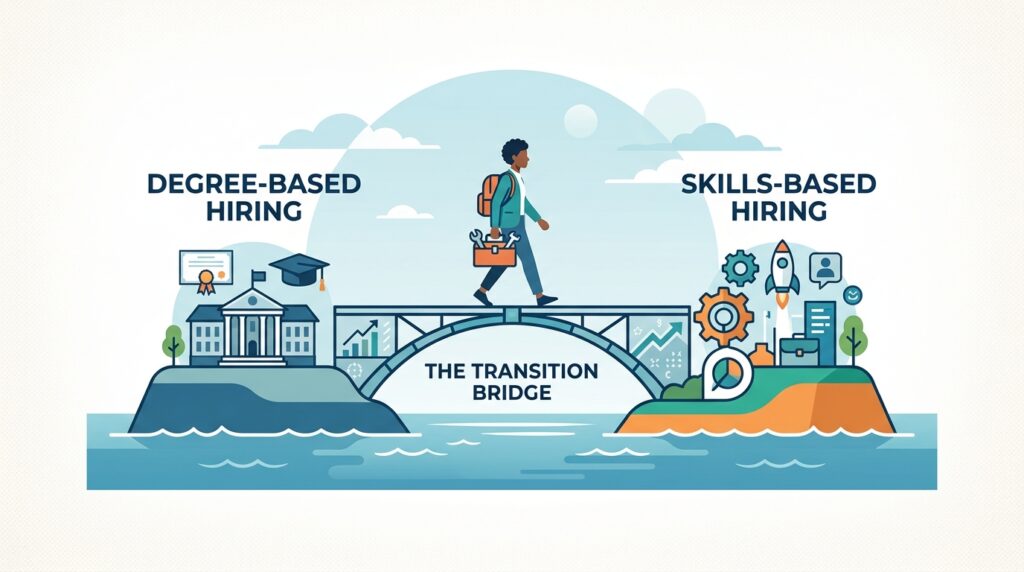
How to Bridge the Gap
If you feel your formal education left you a few steps behind the current industry requirements, don’t worry—most people are in the same boat. The Nigerian tech sector is fueled by “self-starters.”
The secret to landing the job in 2026 is simple: Close the gap between what you know and what the industry needs.
Need a Practical Path Forward?
Sometimes, self-study isn’t enough. If you’re looking to transition into a high-demand career or sharpen your technical and professional soft skills, our team at Apexium offers specialized training and consulting designed specifically for the 2026 Nigerian market.
We focus on the “Real-World Gap”—moving you from theoretical knowledge to ship-ready competence. Whether you are an individual looking to upskill or a business needing to train your team for the AI era, we have the roadmap.
Final Thoughts: The 2026 Mindset
Employers in Nigeria are no longer looking for “perfect” candidates; they are looking for resilient problem-solvers. They want people who can navigate the unique challenges of the Nigerian infrastructure, understand the local “vibe,” and execute with global-standard quality.
Stop worrying about your degree and start building your Evidence of Impact. That is the currency of the future.



Keeping this in mind for 2026