

In 2026, many Nigerian SME owners still operate under the dangerous assumption that they are “too small” to be a target for cybercriminals. The statistics tell a different story: Cybersecurity is no longer a corporate luxury; it is a business survival imperative.
With Nigeria accounting for approximately 45% of reported cyberattacks in Africa, the digital landscape has become increasingly volatile. For an SME, a data breach is not just an IT problem—it is a catastrophic financial event.
1. The Numbers Behind the Disaster
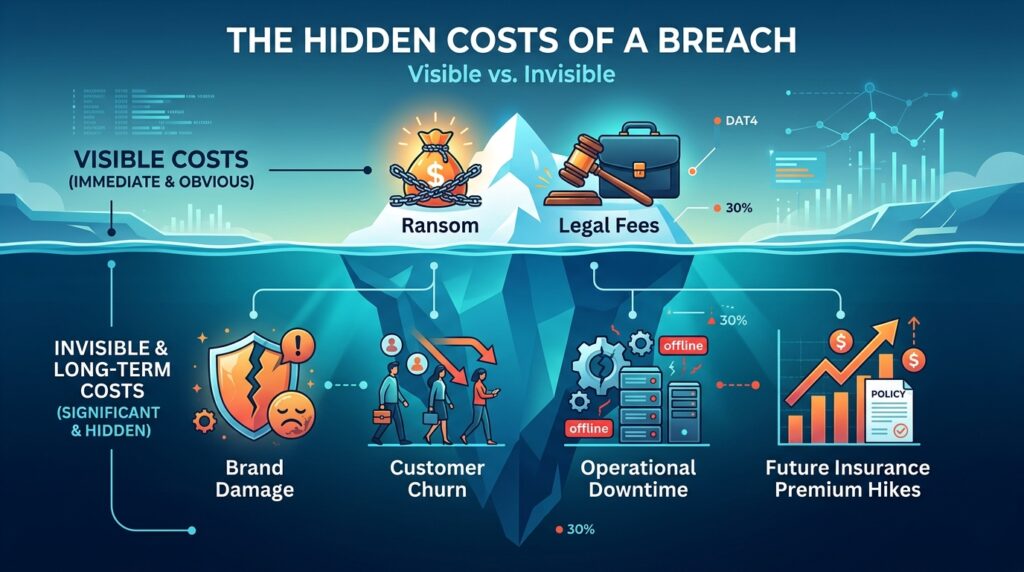
The cost of a breach is rarely just the “ransom” paid to hackers. It is a compounding series of financial drains:
- The “60% Rule”: Research consistently shows that 60% of small businesses that suffer a significant cyberattack go out of business within six months. The operational downtime and loss of customer trust are often insurmountable.
- The Cost of Inaction: Recent reports indicate that businesses with fewer than 200 employees lose an average of $2.5 million (or local equivalent in operational value) per cyber incident when factoring in total recovery costs.
- The Nigerian Reality: Nigeria experiences over 4,000 cyberattacks every week, with cumulative annual losses reaching into the billions of Naira.
2. Breaking Down the Costs
When your systems go dark, the “meter” starts running immediately. Here is where the money goes:
| Cost Category | Description |
| Operational Downtime | Revenue lost for every hour your systems are offline or unable to process payments. |
| Recovery & Remediation | Costs for forensic experts, system restoration, and replacing compromised hardware. |
| Regulatory Penalties | Under the NDPA, fines can reach ₦10 million or 2–3% of your annual revenue, whichever is higher. |
| Reputational Churn | The loss of lifetime customer value as clients migrate to competitors they deem more secure. |
| Legal & Notifications | Costs associated with mandatory breach notifications and potential litigation from affected customers. |
3. The NDPR Compliance Trap
In 2026, the Nigeria Data Protection Commission (NDPC) is actively enforcing the Nigeria Data Protection Act (NDPA). A breach is not just a private issue between you and your hackers; it is a legal trigger.
- Mandatory Reporting: You are legally required to report a personal data breach to the NDPC within 72 hours.
- The “Accountability” Standard: If you cannot prove you had reasonable security measures (encryption, access controls, backups), the NDPC is much more likely to impose the maximum fine, rather than a lenient warning.
The Takeaway: Resilience is an Investment
The most expensive way to handle a data breach is to wait until it happens. SMEs that invest in proactive resilience—such as enabling FIDO2 hardware keys, conducting regular backups, and training staff to spot AI-driven phishing—drastically reduce their recovery time and cost.
Are you confident that your business could recover from a total system compromise within 24 hours?
If the answer is “no,” it’s time to move security from your “someday” list to your “this week” list. Our team at Apexium provides specialized consulting to help Nigerian SMEs build cost-effective, resilient security architectures that satisfy both the NDPC and your customers’ trust.
Click here to schedule a security gap assessment with Apexium today.